The Solar Equity Paradox: How Australia’s ‘Solar Sharer’ Scheme and Decentralized Grids are Rewriting the Energy Playbook
At high noon, Australia’s electricity grid is practically drowning in clean, dirt-cheap power. Yet, a quiet injustice plays out on the ground: millions of renters and low-income families remain locked out of this rooftop solar gold rush. They watch their utility bills march upward while massive, utility-scale solar farms are literally switched off to save the grid from overloading. This isn’t just an engineering mismatch; it’s a profound structural crisis known as the “grid-defection death spiral.”
As wealthier homeowners slap solar panels on their roofs and dodge traditional utility bills, the fixed overhead of maintaining the physical wires falls onto a shrinking, less affluent pool of captive customers. The clean energy transition is no longer just about generating green electrons—it’s about who gets to afford them.
But a reckoning is coming. With the highly anticipated Solar Sharer scheme scheduled to launch in July 2026, Australia is trying to flip this equation, turning the infamous midday “duck curve” of excess generation into an economic lifeline for the households that need it most.
The Midday Glut and the Curtailment Bottleneck
Australia has built a solar empire, but we’ve run straight into a hard physical ceiling. The grid is choking on its own abundance. Fresh data from the Australian Energy Market Operator’s (AEMO) Q1 2026 Quarterly Energy Dynamics (QED) report reveals that distributed solar output just hit an unprecedented 4,090 MW—a massive 8.1% increase compared to the same period last year. For a few hours every day, rooftop solar practically erases midday demand.
Yet, without a smart way to direct this deluge, we are wasting clean energy on a staggering scale. In 2025, curtailment across the National Electricity Market (NEM) skyrocketed to a record over 7 TWh, with solar projects bearing 52% of that forced shutdown. South Australia bore the brunt of this bottleneck, dumping 38% of its utility-scale solar output simply because the transmission lines couldn’t handle the load.
This isn’t just an environmental shame; it’s an economic wound. When developers are forced to dump their product, they recoup losses by driving up retail prices later. This systemic waste is what birthed the Solar Sharer scheme, which will go live this July 2026 across South East Queensland, New South Wales, and South Australia.
Key Takeaway: The Solar Sharer scheme democratises solar benefits by offering households with smart meters at least three hours of free daytime electricity daily during peak solar generation hours, regardless of whether they own rooftop solar panels.
The Mechanics of ‘Solar Sharer’: Who Pays for ‘Free’ Power?
How do you give away electricity for free without bankrupting the system? The answer lies in the wild, volatile world of wholesale pricing. During peak solar hours, wholesale prices don’t just drop to zero—they crash into negative territory, sometimes hitting the absolute market floor of -$1,000/MWh. At that point, fossil-fuel plants and major solar farms are literally paying the grid to take their power, because shutting down and restarting these massive facilities costs more than absorbing the temporary loss.
The Solar Sharer scheme turns this market pain into consumer gain through smart-meter-linked billing automation. No clunky paperwork, no bureaucratic red tape. Instead, the software integrates directly into the billing engines of major gentailers like Origin Energy and AGL. The moment wholesale prices dive below zero, these systems automatically trigger a zero-cent tariff for eligible households during a three-hour midday window.
It is an elegant, self-correcting loop: by encouraging people to run appliances when power is overflowing, retailers clear the market glut, dodge negative-pricing penalties, and keep the grid from melting down.
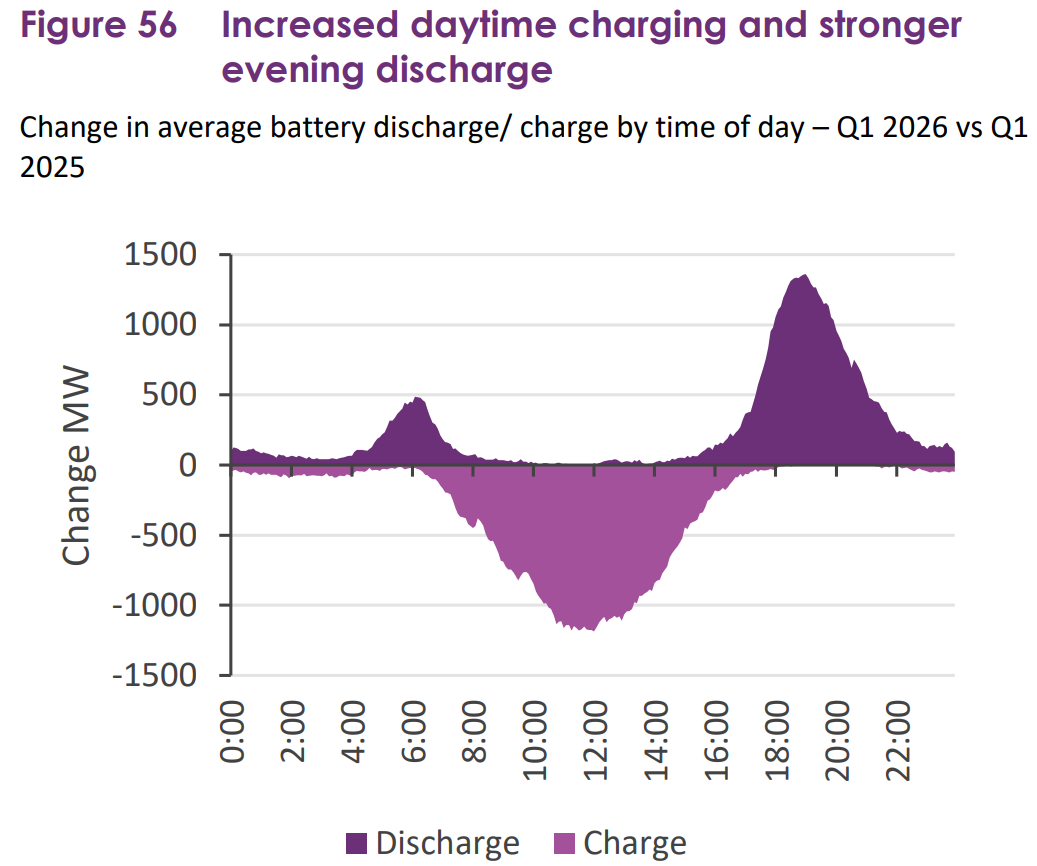
This zero-cost window has also completely transformed how Australians charge their electric vehicles. The surge in daytime EV fleet charging throughout 2026 is a direct consequence of these smart tariffs. As Vehicle-to-Grid (V2G) bidirectional charging matures, these cars are becoming decentralised power plants on wheels—soaking up free midday electrons and feeding them back into homes or the grid during the expensive evening peak.
The Battery Boom and the Grid-Forming Revolution
Shifting demand is only half the battle; the rest comes down to storage and system strength. The first quarter of 2026 has shown an explosive acceleration in utility-scale energy storage. A massive 4,445 MW / 11,219 MWh of large-scale battery capacity has plugged into the NEM, sending average battery-driven generation up by over 300%.
But the real story is under the hood. Traditionally, coal and gas plants kept the grid stable through the brute physical momentum of their massive spinning turbines—a property called system inertia. As those plants retire, we need a digital equivalent. That is why 74% of battery storage projects in the current NEM pipeline are integrating Grid-Forming Inverters (GFIs).
Unlike older grid-following batteries that merely react to the grid, grid-forming systems actively dictate and stabilise voltage and frequency. They are the software-driven heartbeat of a modern, post-coal grid.
In Australia’s industrial heartlands, mining giants aren’t waiting for public infrastructure to catch up. They are building their own off-grid ecosystems. Fortescue, for instance, has broken ground on a 690-megawatt solar farm at Turner River (slated to come online in 2028) paired with a 650-megawatt-hour battery energy storage system at Cloudbreak (expected to drop in the 2026-27 financial year). Together, these assets form the backbone of the Pilbara Green Grid, a massive bid to run heavy mining operations on localized, self-stabilizing microgrids.
Democratizing Solar: Subscription Models and VPPs
For millions of everyday households, buying a $10,000 solar-and-battery system is an impossible dream. To bridge this gap, the private sector is rethinking ownership. In April 2026, retail giant Bunnings expanded its Zelora program into Queensland, Victoria, and South Australia after a highly successful pilot in New South Wales.
Partnering with energy tech pioneer Intellihub, the program replaces upfront costs with a simple monthly subscription. It’s a massive win-win: these setups can boost home values by 2% to 4% (adding roughly $20,000 to $30,000 in equity) while trimming annual power bills by anywhere from $800 to $3,500.
At the same time, these subscription-backed households are linking their batteries into Virtual Power Plants (VPPs). By pooling thousands of small batteries together, VPPs create a single, massive virtual battery that can inject power back into the grid during the profitable evening peak, giving everyday citizens a direct slice of the wholesale market.
The Global Dimension: Comparing Grid Transitions
This tension between clean energy abundance and grid equity isn’t unique to Australia. The exact same drama is playing out across the Global South, most intensely in India. A close look at India’s power sector reveals an identical structural vulnerability: when wealthy families and massive factories go off-grid, the heavy bill for maintaining the physical network is left on the desks of the poor.
| Metric / Feature | Australia’s Decentralized Model (2026 Status) | India’s Grid & Reform Model (Post-2025/2026) |
|---|---|---|
| Primary Equity Mechanism | Solar Sharer (free midday power via smart-meter automation) & VPPs. | State-level free electricity units (e.g., Delhi, Rajasthan) & Direct Benefit Transfers. |
| Grid Integration Tech | Rapid deployment of Grid-Forming Inverters (GFIs) and home batteries. | Focus on Green Energy Corridors and large-scale transmission infrastructure. |
| Industrial Impact | High-penetration C&I captive solar; microgrids (e.g., Fortescue’s Pilbara Green Grid). | High cross-subsidisation tariffs on C&I; Draft Electricity Amendment Bill, 2025 aims to reform this. |
| Key System Challenge | High curtailment (7 TWh in NEM in 2025) and evening ramp-up (the Duck Curve). | DISCOM debt, fixed-cost recovery shifts, and grid stability under rising demand. |
In India, commercial and industrial (C&I) players have long paid inflated rates to subsidize cheap power for rural homes. But as those lucrative industrial customers build their own captive renewable projects and wealthy urbanites install rooftop solar, state-run distribution companies (DISCOMs) are losing their cash cows.
The math is brutal: the fixed costs of the grid get squeezed onto the poorest households, triggering a dangerous spiral of rising tariffs and unpaid bills. While India’s Draft Electricity (Amendment) Bill, 2025 and the new Draft National Electricity Policy 2026 try to balance this scale, walking the line between keeping industry competitive and keeping the lights on for hundreds of millions remains an incredibly delicate task.
Looking Ahead: Balancing the Scales
The clean energy transition has officially grown up. We have moved past the basic engineering puzzles of the early 2020s—making solar cells cheaper and batteries bigger is no longer the main hurdle. The true challenge of this late-2020s era is distributive justice.
Armed with smart software, automated retail billing, and grid-forming tech, modern energy grids are starting to treat equity not as a charity project, but as a critical grid-stabilising asset. True resilience doesn’t come from building more power plants; it comes from making sure that every single consumer, regardless of their income or housing status, has a stake in our clean energy abundance.
Summary
- Equity Redefined: Launching in July 2026, Australia’s Solar Sharer scheme uses smart-meter automation to deliver free midday electricity to renters.
- Grid Stabilisation: Advanced grid-forming batteries (74% of the pipeline) are rapidly replacing legacy coal assets to secure the network.
- Global Paradox: Australia and India are racing to prevent a spiral where off-grid elites leave vulnerable citizens funding legacy infrastructure.
Related Read:
From Sunlight to Storage: Why India’s PM Suryaghar Must Adopt the Australian ‘Hybrid’ Blueprint