The Nitrogen Trap: India’s Dangerous Addiction to Urea and the Erosion of Agronomic Sovereignty
Why Fertilizer Use Efficiency is the Linchpin for Global Energy and Climate Security
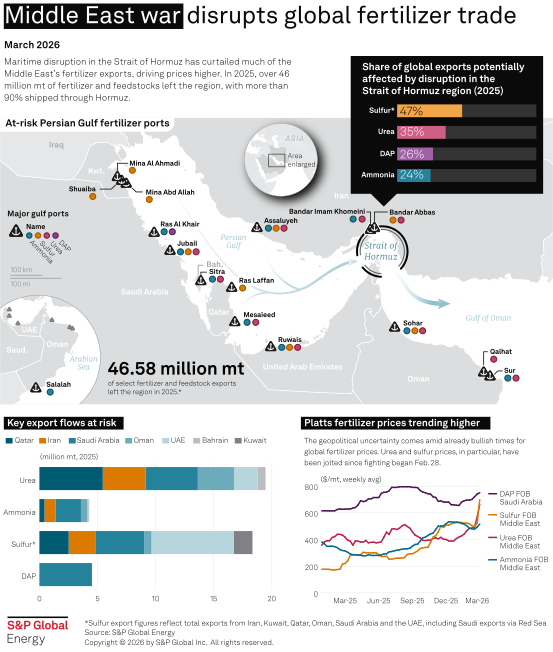
When the Persian Gulf ignited in February 2026, the tremors did more than rattle oil markets; they fractured the very foundation of how the world feeds itself. The United Nations Food and Agriculture Organization (FAO) recently sounded the alarm: the strangulation of natural gas supplies—the lifeblood of nitrogenous fertilizers—is currently gutting agricultural output from the Indo-Gangetic plains to the Yangtze River and the historic breadbaskets of Europe.
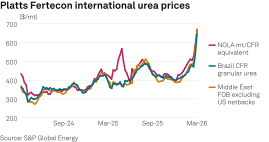
The global fertilizer market didn’t just slip into instability; it fell off a cliff. We have moved from a shaky status quo to a full-blown emergency with a speed that has left analysts breathless. Look at the latest numbers from India Potash Ltd (IPL): they are seeing supply offers for urea swinging between $935 and $959 per tonne. That is a staggering doubling of the rates ($508-$512 per tonne).seen in the just two months ago. It is an inflationary gut-punch that threatens to bankrupt agricultural balance sheets from the Ganges to the Levant.
This isn’t just another hiccup in the supply chain. It is a loud, structural indictment of a broken agricultural philosophy. The great strategic challenge of our era is to solve the “Urea Paradox”—that self-defeating loop where we pour more into the soil only to get less out of it. If we want to survive energy price swings, hit our climate targets, and keep farmers solvent, we have to master a single, clinical metric: Fertilizer Use Efficiency (FUE).
1. The 2026 Energy-Fertilizer Nexus: A Global Vulnerability
The 2026 Middle East flashpoint has stripped away the illusion of food independence. Producing nitrogen fertilizer is a brute-force energy game, gobbling up nearly 4% of the global natural gas supply. In India, the math is even more precarious: roughly 90% of urea consumed is either bought from abroad or cooked up using imported gas. When the Gulf burns, the cost of farming in Punjab or Iowa hits the stratosphere.
This isn’t a local problem. Europe is still limping from the energy shocks of the mid-2020s, while Sub-Saharan Africa has been effectively priced out of existence. To stop the global food supply from being a hostage to fossil fuel volatility, we have to cut the cord. While the dream of green hydrogen is the ultimate goal, the immediate survival tactic is the radical, obsessive optimization of the nutrients we already possess.
Key Takeaway: Governments must pivot from reactive food stockpiling to proactive “nutrient sovereignty.” This requires insulating the agricultural sector from input cost pressures by reducing gas dependency through a relentless focus on FUE.
2. Defining the Urea Paradox: A Tale of Two Giants
To fix the system, we have to confront the Urea Paradox: the bizarre reality where dumping more nitrogen on a field leads to stagnant yields, poisoned soil, and a fiscal black hole of subsidies. It is high-octane consumption with low-octane results.
At the heart of this mess is Fertilizer Use Efficiency (FUE)—the simple ratio of what the plant actually eats versus what we throw at it. Right now, global nitrogen efficiency is an embarrassment, hovering between 30% and 50%. This means more than half of the urea we buy is literally vanishing—either drifting into the sky as heat-trapping gas or bleeding into our water.
Global Fertilizer Consumption & Performance (2025-26 Estimates)
| Country | Urea Consumption (Million Tonnes) | Productivity Insight | Strategic Direction |
|---|---|---|---|
| India | 150 | High usage; low output per unit; $20B+ subsidy burden. | Transitioning to Green Hydrogen & Nano Urea. |
| China | 145 | Higher food production per unit than India; declining intensity. | Focused on self-sufficiency and organic substitution. |
| USA | 22.5 | High efficiency via precision tech; high environmental runoff. | Adoption of 4R Stewardship and EENFs. |
| Bangladesh | 36.6 | High intensity in rice-heavy systems; high wastage. | Implementing Urea Super Granules (USG). |
| Brazil | 12.8 | Rapidly growing demand; high import dependency. | Precision nutrient management and bio-fertilizers. |
While China and India are the heavyweights, their paths are diverging. China has begun a process of “de-bulking”—slashing the volume of chemicals while keeping yields high through sheer precision. India, meanwhile, is in a race against time to break its “bulk” addiction before it bankrupts the national treasury and kills the soil for good.
3. India Story: The Great Imbalance
The numbers coming out of the Ministry of Chemicals and Fertilisers (2023-24) are harrowing. Instead of sticking to the 4:2:1 ideal, the national average has drifted into a bloated 9:3:1. In the industrial farming hubs of Punjab and Haryana, the numbers are even more distorted. It is a “steroid effect”: plants are gorged on Nitrogen, forced into a sprint of growth without the structural skeleton or root system to hold them up.
State-wise NPK Consumption Ratios (2024–25)
The data shows a massive imbalance in several key agricultural states, particularly regarding the overuse of Nitrogen.
| Region / State | Nitrogen (N) | Phosphorus (P) | Potash (K) | Status vs. Ideal |
|---|---|---|---|---|
| Scientific Ideal | 4 | 2 | 1 | ✅ Balanced |
| All-India Average | 9.3 | 3.5 | 1 | ⚠️ High Urea Use |
| Nagaland | 101.0 | 5.8 | 1 | 🚨 Extreme Imbalance |
| Rajasthan | 45.7 | 15.0 | 1 | 🚨 High Imbalance |
| Punjab | 29.8 | 6.5 | 1 | 🚨 High Imbalance |
| Haryana | 29.2 | 7.3 | 1 | 🚨 High Imbalance |
| Uttar Pradesh | 22.7 | 6.7 | 1 | 🚨 High Imbalance |
| Madhya Pradesh | 15.3 | 6.8 | 1 | ⚠️ Imbalanced |
| Bihar | 11.0 | 3.3 | 1 | ⚠️ Imbalanced |
| Maharashtra | 4.2 | 2.5 | 1 | 🌿 Near Ideal |
| West Bengal | 2.7 | 1.5 | 1 | 🌿 Near Ideal |
| Kerala | 1.4 | 0.6 | 1 | 🌿 Balanced |
The national average hides some truly terrifying outliers. In Nagaland, the ratio has hit a surreal 101:1. This isn’t just a statistical quirk; it’s a warning of what happens when traditional systems break. As the ancient practice of shifting cultivation (Jhum) collapses, intensive chemical farming has been rushed in without the safety net of local soil testing. The result is ecological arson. When Nitrogen hits these levels, soil acidity goes through the roof, the microbial life that naturally fixes nitrogen is wiped out, and the land’s ability to store carbon is effectively neutralized.
3. The Economic Imperative: A $1 Trillion Opportunity
Moving toward a “Green Urea” model isn’t just environmental altruism—it’s a massive economic engine. Modern modeling suggests that a total overhaul of the fertilizer sector could unlock a global windfall of $1 trillion over the next 25 years.
- Farmer Prosperity: Precision Nutrient Management (FPNM)—using soil sensors, satellites, and variable-rate tech—has proven it can slash fertilizer bills by 15.6% while actually boosting net income by 14.5%.
- National Savings: India’s National Green Hydrogen Mission, backed by a ₹19,744 crore war chest, is designed to decouple urea from the gas pump. Moving to green ammonia is the only way to shield the farm sector from the next geopolitical explosion.
- The Subsidy Shift: If we can double our nitrogen efficiency, governments can stop burning billions on price supports and start investing that money in rural high-speed data and smart infrastructure.
Implementation Challenges: Of course, the road is bumpy. The upfront costs (CAPEX) for green hydrogen are staggering, and the “behavioral inertia” of farmers who have spent decades being told “more is better” is a massive hurdle. Success won’t come from tech alone; it requires a complete rethink of how we incentivize the man in the field.
4. Mitigation Through Precision: The Climate Angle
Agriculture is responsible for about 20% of the world’s greenhouse gases. A huge chunk of that comes from urea turning into Nitrous Oxide (N2O)—a gas that is 300 times more destructive to the climate than CO2.
The fix lies in Enhanced Efficiency Nitrogen Fertilizers (EENFs) and the 4R Nutrient Stewardship code:
- 4R Stewardship: Getting the Right Source at the Right Rate, at the Right Time, and in the Right Place.
- Nano Urea: This is a game-changer. It’s a liquid that enters the plant through the stomata. Because the particles are microscopic, they hit nearly 80% efficiency, making old-school granular urea look like a relic of the industrial revolution.
- Urea Super Granules (USG): Think of these as deep-tissue nutrients. By placing them deep in the mud of rice paddies, we stop the runoff and the evaporation.
- GHG Reduction: If we get the water and the fertilizer right, we can drop rice-related emissions by 39.17%. Optimized management (OPT) can cut N2O emissions by a staggering 42.6%.
5. The Path Forward: Technology and Policy
If we want to stop our food security from being a casualty of Middle Eastern wars, the strategy has to be aggressive:
- Green Hydrogen Integration: We must force the transition of gas-based urea plants to green ammonia by 2050. No excuses.
- IoT & Sensors: We need to put handheld NIR devices and canopy sensors in the hands of every farmer so they can read their crops’ hunger in real-time.
- Alternative Nutrients: It’s time to scale up biochar and cattle urine—ancient methods that are showing massive promise in places like Ethiopia.
- Policy Feedback: Stop subsidizing the sheer volume of chemicals. Start rewarding farmers who can prove they are sequestering carbon and building soil health.
Strategic Insight: The road to a resilient agricultural sector goes through a reformed fertilizer sector. We can halve urea consumption without compromising food production by strengthening policies that promote natural farming and enhance NUE.
Summary
- Security via Efficiency: High FUE is the only viable shield against energy-driven inflation and the chaos of gas markets.
- The Trillion-Dollar Pivot: Precision tech and green hydrogen offer a massive economic windfall for nations willing to “de-bulk” their fields.
- Climate Recovery: Using 4R Stewardship and Nano-tech can slash agricultural emissions by 40% while