How Renewable Energy is Fueling a Groundwater Crisis in South Asia
The global push for renewables is usually sold as a sanitized narrative of environmental salvation—a high-tech silver bullet for a feverish planet. But in the dust-caked “breadbasket” of the Indo-Gangetic Plain, a far more predatory Water-Energy Nexus is taking hold. While solar-powered irrigation is pitched as a carbon-neutral escape from the volatility of fossil fuels, its unchecked explosion is creating a toxic feedback loop. By erasing the marginal cost of extraction, solar energy is effectively subsidizing the race to the bottom of South Asia’s aquifers, turning a green revolution into a slow-motion hydrogeological suicide.
The “Majburi” Shift: From Cotton to Thirsty Paddy
This crisis didn’t emerge in a vacuum; it was born from old scars. For decades, North India’s aquifers have been the most aggressively bled on earth, with water tables in the agricultural heartlands of Punjab and Haryana hemorrhaging between 0.5 to 1 meter annually.
In these states, the pivot to solar isn’t some idealistic “green” choice. It is a reflex born of desperation. Since 2017, the Pink Bollworm (PBW) has systematically gutted the cotton industry, once the region’s economic spine. Left with few options, farmers have retreated into the safety of the only crop the state reliably buys: Paddy (Rice).
The irony is sharp. Rice is a liquid glutton, swallowing roughly 2,500 liters of water for every single kilogram of grain produced. To keep these fields flooded in a region where the power grid is a fickle ghost, farmers are sidestepping state-regulated lines and expensive diesel in favor of off-grid solar rigs.
- Capital Investment: Farmers are dropping between ₹1.25–2.5 lakh (roughly $1,500–$3,000) on 3 to 7.5 HP solar pumps—a heavy one-time “insurance premium” against the rising cost of staying alive.
- Infrastructure Depth: Private crews work fast, sinking tubewells to depths of 35–80 feet—a threshold that keeps dropping as the shallow layers are hollowed out.
- The Regulatory Void: While the official PM-KUSUM scheme tries to keep tabs on things, the “gray market” of private, off-grid installations operates in a legal blind spot, invisible to any water regulator.

Editor’s Insight: Farmers call this shift “majburi”—a word that translates to “compulsion” but feels more like “no choice.” As a farmer in Sirsa put it, “The water is going, I know. But the sun costs nothing and the government pays for the rice. If the pump stops, we stop eating. I can’t afford to worry about the future.” Solar power has decapitated the cost of over-pumping, making it economically rational to destroy the resource you depend on.
The Transboundary Crisis: Pakistan’s 45% Grid Collapse
The crisis ignores the Radcliffe Line. Across the border, Pakistan is in the throes of its own “Solar Revolution,” one that is gutting the nation’s energy economics and water security simultaneously.
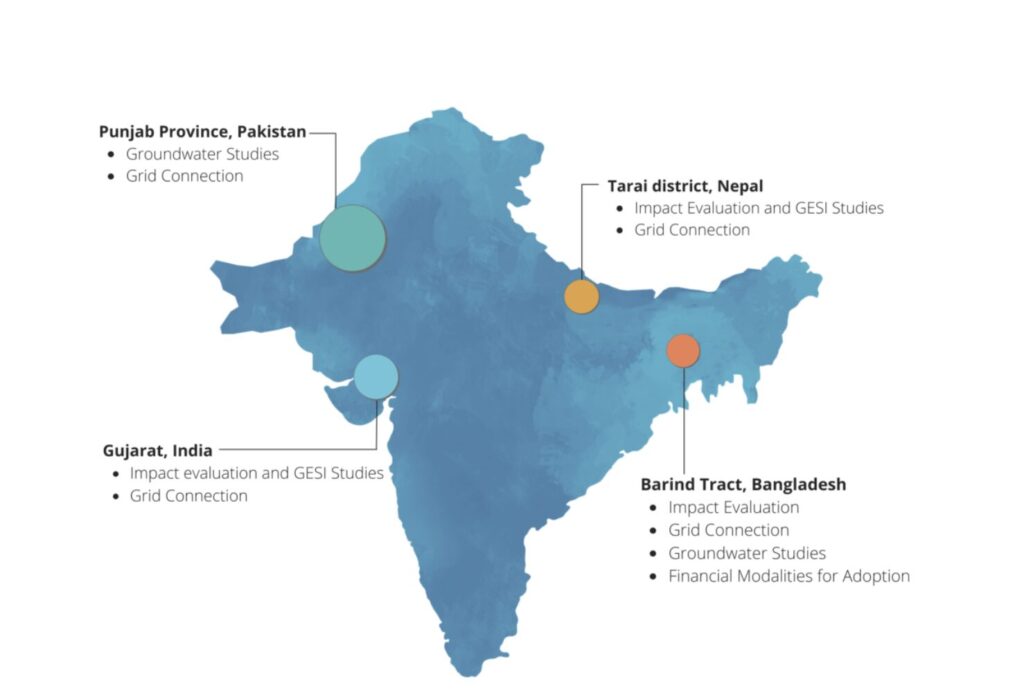
In rice hubs like Muridke, the hum of solar tubewells is the sound of a falling water table.
The scale of this tectonic shift is staggering. Between 2023 and 2025, Pakistan’s agricultural landscape has been re-engineered by a silent, sun-driven boom:
- Crop Displacement: Rice acreage has ballooned by 30%, while maize—a much smarter, water-efficient alternative—has shrunk by 10%.
- Utility Death Spiral: The national energy sector is staring at a 45% collapse in grid consumption from the agricultural sector by 2025. As 400,000 tubewells migrate to solar and 250,000 new units are bolted down, the grid loses its most reliable revenue stream, pushing an already fragile energy infrastructure toward a total meltdown.
Comparative Impact: The Architecture of Extraction
| Feature | Diesel Powered Pumps | Grid Electricity | Off-Grid Solar Pumps |
|---|---|---|---|
| Marginal Cost | High (Market Fuel Price) | Low (Subsidized/Fixed) | Zero (The Sun is Free) |
| Operational Reliability | High but expensive | Low (Load-shedding/Outages) | High (Constant Daylight) |
| Regulatory Oversight | Self-regulated by fuel cost | Regulated by Utility/Meter | None (Invisible to State) |
| Extraction Pattern | Conservative/Needs-based | Restricted by supply hours | Continuous/Unlimited |
The Invisible Threat: The “Silent Vacuum”
The real danger here is the total erasure of marginal cost. In the diesel era, every hour the pump ran was a literal drain on the farmer’s wallet. On the grid, the state at least controlled the hours of operation—usually limited to erratic night-time windows.
Solar flips the script. Once the equipment is paid for, the “fuel” is free. This creates three devastating systemic failures:
- Continuous Pumping: Without a “stop” signal from a meter or a fuel bill, farmers saturate paddies far beyond what the soil actually needs. Often, the pumps run simply because the sun is out.
- Inefficient Water Use: In Pakistan, rice fields are now guzzling two-thirds more water than similar climates in Egypt. Why? Because there is zero financial penalty for waste.
- The Arid Expansion: Solar is allowing water-heavy crops to colonize semi-arid zones like Sirsa, where the aquifer has no prayer of recharging. It is extraction without replacement.
Takeaway: Solar’s reliability is a lifeline for individual farmers but a “silent vacuum” for the collective aquifer. Without a way to “price” the sunlight or the water it extracts, we are simply trading a carbon disaster for a total regional water collapse.
The Policy Frontier: Can Solar Become a “Cash Crop”?
Banning solar is a non-starter; the climate and rural development benefits are too massive to ignore. The trick lies in re-engineering the “free” nature of the energy. Policymakers are looking at the Gujarat Model (the SKY scheme) as a potential, if difficult, escape hatch.
The logic is simple: link the pumps back to the grid and let the state buy the excess power.
- The Economic Pivot: If a farmer makes more money selling electricity to the utility than by pumping water for low-value rice, the incentive flips from extraction to conservation.
- The Challenges: This isn’t easy. It demands a massive overhaul of “smart” grid tech and faces deep skepticism from farmers who don’t want the government looking over their shoulder. Plus, the high buy-back rates could bankrupt state utilities if not managed perfectly.
Beyond the Grid: A Multi-Pronged Approach
To stop the bleed, solar must be stapled to radical agricultural reform:
- Drip Irrigation Mandates: No solar subsidy should exist without a requirement for high-efficiency drip systems. Flood irrigation must become a relic.
- Crop Diversification: The state has to make millets or pulses as profitable as paddy. If the market doesn’t support “dry” crops, farmers will keep growing “wet” ones.
- Community Aquifer Management: We have to stop treating water as private property and start managing it as a shared bank account, where withdrawals are capped by annual deposits (recharge).
Summary: The Looming Crisis
- “Unregulated solar power is severing the link between energy costs and water usage, triggering a ‘free’ extraction frenzy that is hollowing out South Asia’s primary aquifers.”
- “The desperate shift from cotton to thirsty paddy, enabled by off-grid solar, is driving a transboundary hydro-crisis that traditional utility regulations are powerless to monitor or halt.”
- “Preventing total regional collapse requires pivoting solar from an extraction tool into a sellable ‘cash crop’ while mandating high-efficiency irrigation and aggressive crop diversification.”