The Duck, the Camel, and the Missing Grid: Why the EAC-PM’s Solar Warning is Too Little, Too Late
This month, Sanjeev Sanyal, Member of the Prime Minister’s Economic Advisory Council (EAC-PM), and Joint Director Satvik Dev published a working paper titled “The Duck and The Camel: Tracing the Net Load on the Indian Power Grid.” The document offers a neat diagnosis of a structural rupture in India’s electricity sector. The country’s breakneck solar expansion has flipped the script, turning the primary grid challenge from a crude race for generation capacity into a messy, multi-front war over flexibility, timing, and transmission lines.
But for anyone watching the frontlines of the subcontinent’s energy transition, the high-profile paper prompts a far more uncomfortable question: Is this warning too little, too late?
While Sanyal’s paper lends policy-level gravitas to the “duck curve” (that midday solar glut) and the “winter camel curve” (the brutal evening demand spikes), the ground reality of grid distress is hardly news. These systemic tremors have been rattling the sector for years. The National Electricity Plan (NEP) mapped these exact dynamics long ago, yet actual execution on the ground has lagged catastrophically. By chasing hyper-aggressive solar generation targets while ignoring energy storage, transmission networks, and retail pricing reform, India has essentially built a high-spec Ferrari engine but forgot to bolt on the wheels. (Read more – The Gridlock of Ambition: A Mid-Term Audit of India’s National Electricity Plan (2022–2027))
Elegant Metaphors, Belated Realities: Inside “The Duck and The Camel”
The EAC-PM paper taps SCADA data from Grid-India to chart how a massive deluge of solar power has warped the daily load curve. On May 21, 2026, the national grid managed to hit a record-shattering peak demand of 270.8 GW. But celebrating this milestone ignores the terrifying intraday volatility underneath. At 8:00 AM that morning, demand hovered at 224.1 GW, forcing the grid to absorb a staggering 46.7 GW swing in less than eight hours.
Come winter, this dynamic morphs into what the authors term the “camel curve,” defined by steep, double-humped evening ramps. Operators must steer a 64 GW plunge into the midday solar trough, followed immediately by a matching 64 GW vertical climb back out the moment the sun dips and millions of households switch on their lights and home appliances.
These raw physical imbalances have broken the wholesale electricity market:
- Extreme Price Spreads: On the Indian Energy Exchange (IEX), average midday prices in May 2026 plummeted to a rock-bottom ₹1.11 per unit, while evening peak prices hit the hard regulatory ceiling of ₹10.00 per unit—a wild peak-to-trough ratio of almost 9x.
- Concentrated Shortages: Between April and May 2026, electricity deficits struck on 36 out of 61 days during evening and night-time peaks. By contrast, only six days saw shortages during peak solar hours. Power shortfalls are no longer about coal shortages; they are strictly a matter of timing.
The Retail Blindspot: Frozen Tariffs
Curiously, the most glaring blindspot in the policy toolkit is on the consumer side. While wholesale spot markets experience wild price swings, retail consumers remain blissfully insulated from reality. The central government’s ambitious rollout of Time-of-Day (ToD) tariffs for households and small businesses has hit a brick wall at the state level.
Because the vast majority of consumers still pay flat, heavily subsidised rates, there is absolutely no financial signal to nudge public behaviour. Without dynamic retail pricing to encourage washing machines and water pumps to run at noon, or to penalise heavy usage during evening peaks, the “Camel Curve” will remain stubbornly unflattened. This leaves grid managers entirely dependent on supply-side fixes that simply do not exist at scale yet.
The Neglected Pillars: Storage, Transmission, and Hydrological Fragility
The real sting of the critique against Sanyal’s paper is that none of these hurdles are sudden discoveries. They are the predictable fallout of a massive policy mismatch: the state aggressively chased headline-grabbing solar targets while dragging its feet on the storage and transmission capacity needed to hold the grid together.
1. The Storage Vacuum
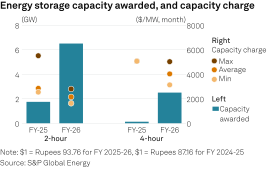
To smooth out even half of a standard summer evening demand ramp, India needs roughly 130 GWh of active energy storage discharge capacity. Yet, in May 2026, the country’s combined pumped hydro storage (PHS) and battery energy storage systems (BESS) managed to discharge a measly daily average of just 23.8 GWh.
Even with recent rollouts boosting grid-scale BESS capacity to 2.7 GW by mid-2026, our starting baseline remains pathetically low. For years, regulators cleared solar farm after solar farm with zero storage mandates. It was only in early 2026, as we have observed over the last six months, that serious domestic manufacturing finally got moving—highlighted by Waaree Energies’ announcement of a 16 GWh integrated lithium-ion gigafactory in Andhra Pradesh and Replus Engitech scaling up its utility-scale BESS output.
2. The Transmission Collapse and the State-Central Divide
Transmission infrastructure has fared even worse, hamstrung by a massive gulf between central planning and state-level execution. Over the preceding fiscal cycles, actual physical transmission line additions hit their worst slump in a decade.
- In FY2024-25, India commissioned just 8,830 circuit kilometres (ckm) of new transmission lines against a target of 15,253 ckm—a massive 42% deficit.
- While the central Inter-State Transmission System (ISTS) has run into delays, the gridlock is far worse at the State Transmission Utility (STU) level. Broke state distribution companies (discoms) have consistently failed to build intra-state lines, creating severe local bottlenecks that trap cheap solar power far away from regional consumption centres.
- This execution disaster is perfectly illustrated by the Green Energy Corridor (GEC) Phase-II initiative. Built to evacuate 20 GW of renewable power across eight states, GEC Phase-II has hit a wall of delays triggered by local right-of-way (RoW) disputes, forest clearance snags, and a tight global supplier market for vital high-voltage direct current (HVDC) components.
3. Hydrological Fragility: The Failure of the Hydro “Peaker”
Historically, planners expected massive hydropower plants to step up as the ultimate “peaking” assets to handle the steep evening “Camel” climb. However, 2026 has brutally exposed the structural weakness of relying on this strategy.
Unpredictable monsoons and shrinking Himalayan glacial melt, coupled with severe silt build-up in run-of-the-river projects, have squeezed actual hydro availability. Instead of ramping up smoothly to match the post-sunset surge, hydro reservoirs have been forced to hold back water for drinking and irrigation. This hydrological deficit has left grid operators with no choice but to fire up expensive, dirty coal plants or dump clean energy altogether to keep the grid from collapsing.
4. Coal Inflexibility and the Case for a Policy Pause
The grid’s inability to cope has been worsened by the thermal fleet’s lack of flexibility. Keeping coal plants operating above their minimum technical limits (MTL) forced the curtailment of 2.1 TWh of renewable generation in FY2025-26, resulting in Rs 629 crore of foregone electricity.
By April 2026, peak-hour curtailment had returned to 4% of solar and wind generation, and emergency Tertiary Reserve Ancillary Service (TRAS) down curtailment had crossed 3,600 GWh by early June 2026.
This brings us to the core policy critique: Should the government have relaxed solar targets until storage and transmission infrastructure were ready?
The answer is a resounding yes. By blindly chasing headline-grabbing solar installation targets (reaching 154 GW by April 2026) without matching grid integration capabilities, policymakers have created an environment of high curtailment, depressed developer returns, and grid instability.
Furthermore, policies like the Approved List of Models and Manufacturers (ALMM) List-II (ALCM), which became effective on June 1, 2026, have restricted cell sourcing to domestic manufacturers, adding procurement friction at the exact moment the sector needs rapid, flexible deployment.
The Cost of Uncoordinated Planning: Massive Curtailment
With storage missing in action, transmission grids lagging behind, and hydro capacity constrained, the system has resorted to the worst-case option: massive Variable Renewable Energy (VRE) curtailment. Clean, cheap solar power is literally being dumped.
| Metric / Event | Grid Reality (FY 2025-26 / Mid-2026) | Policy Target / Requirement |
|---|---|---|
| Solar Capacity Added (Oct 2025 – Apr 2026) | 24 GW (pushing the total to 154 GW) | Rapid capacity additions with no matching grid upgrades |
| Renewable Energy Curtailed (FY 2025-26) | 2.1 TWh (amounting to 1.3% of total RE) | Target: Zero waste (0% curtailment) |
| Transmission Construction Gap (FY 2025) | 42% gap (8,830 ckm built against 15,253 ckm target); GEC Phase-II heavily delayed | Target: Perfect execution to avoid structural bottlenecks |
| Single-Day Generation Loss (March 30, 2026) | 34 GWh dumped owing to network constraints | Equal to the daily consumption of 5 million homes |
| Storage Capacity Available (Mid-2026) | 2.7 GW BESS / 23.8 GWh average daily discharge | 130 GWh required to smooth summer evening spikes |
| Hydro Peaking Availability (Mid-2026) | ~15% shortfall in peaking capability due to dry reservoirs | Full availability to handle the evening “Camel” peak |
| Retail ToD Tariff Rollout (Mid-2026) | Under 15% uptake in home/SME sectors due to state-level foot-dragging | Universal smart meters and real-time dynamic pricing |
The fallout from this uncoordinated rush is painfully obvious:
- The Coal Dilemma: To keep the grid stable, thermal plants must run above their Minimum Technical Level (MTL). Keeping these coal boilers hot forced operators to dump 2.1 TWh of clean power in FY 2025-26.
- Wasted Generation: In the first quarter of 2026 alone, India threw away 300 GWh of clean electricity simply because there weren’t enough wires to carry it.
- Ancillary Service Strain: Renewable power dumped under the emergency Tertiary Reserve Ancillary Service (TRAS) down mechanism surged to over 3,600 GWh by early June 2026, a massive spike from practically nothing in mid-2025. On peak days in May 2026, daily curtailment topped 120 GWh.
Without sufficient flexibility, including storage, this could become a constraint on the next phase of renewable energy growth. Read more on
Shifting the Blame: Tough Rules and Investor Panic
Instead of fixing the state’s failure to build out transmission lines, update retail tariffs, or build utility-scale storage alongside solar plants, regulators have decided to beat up on developers.
The Central Electricity Regulatory Commission (CERC) has drawn up draconian grid discipline codes, scheduled to kick in by April 2027. These rules will slap heavy financial penalties on renewable power producers who fail to deliver power matching their exact, forecasted commitments.
This move has spooked the market. Private equity and strategic investors—who put $460 million into Indian solar manufacturing in 2026—warn that these punitive measures will gut project returns. Ultimately, this risk premium could dry up the massive wave of capital required to hit India’s ambitious 500 GW non-fossil fuel capacity target by 2030.
Sanyal has often drawn flak for blaming India’s deep structural failures on secondary actors—like the judiciary or state-level power boards—while letting central executive planners off the hook. This new working paper fits the same pattern. It paints the “Duck and Camel” phenomenon as a natural, almost inevitable side-effect of rapid solar success, rather than calling it what it truly is: a predictable failure of central planning to align solar generation with the grid infrastructure to back it up.
Conclusion: The Case for Synchronized Energy Planning
The EAC-PM working paper serves as an incredibly readable, data-dense diagnostic of the Indian power grid’s current fractures. But as an advisory brief, it arrives long after the damage has set in. The severe power curtailments of late 2025 and early 2026 were not acts of God—they were entirely preventable.
Had the central government paced its mega solar tenders to match the real-world commissioning of interstate transmission corridors, mandated battery storage in auctions, and forced states to implement retail ToD tariffs, billions of clean kilowatt-hours wouldn’t have been throw away. Moving forward, the Ministry of Power must start treating BESS as a critical, standalone grid asset, fast-track the planned 61,411 ckm of transmission lines under GEC Phase-II, and ensure no new solar projects are greenlit without dedicated evacuation lines and storage capacity.
Until generation and infrastructure planning are perfectly synchronised, India’s proud solar boom will keep slamming straight into the hard physical limits of an unready grid.
Summary of Key Insights
- The Flexibility Deficit: A record 270.8 GW demand peak in mid-2026 exposed a grid starved of battery backup, forcing heavy solar curtailment.
- Infrastructure Bottlenecks: Delayed transmission corridors, state-level network failures, and frozen retail tariffs have stalled necessary grid adaptation.
- Policy Disconnect: Severe regulatory penalties on developers threaten to dry up international private investments needed for 2030 targets.